hannes meyer (1889 — 1954)
Hannes Meyer foi docente e o segundo director da Bauhaus. Um arquitecto suico empenhado politicamente, tendo desenvolvido projectos para habitação e equipamentos sociais bem como planos de urbanização, na Suiça, Alemanha, URSS e México, onde viveu. Foi director da Bauhaus de 1928 a 1930
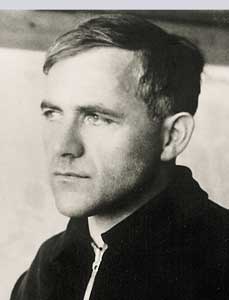
Destacam-se os projectos para uma escola em Basileia (1926 ), para o concurso do Palácio das Nações em Geneva (Völkerbundpalast Genf, 1926-27), o bairro Törten em Dessau (1928-30) ou a Escola da Federação dos Sindicatos Alemães (1928-30) e ainda planos de urbanização para Moscovo e outras cidades russas (princípio dos anos 30).
Na Bauhaus, as aulas de Meyer eram baseadas no seu profundo conhecimento da construção. Para ele, construir era um processo elementar que exigia considerar as necessidades humanas — biológicas, intelectuais, espirituais e físicas. Por isso, era necessário tomar em consideração a totalidade da existência humana.
«Construir é um processo biológico» - manifesto de 1928
Em 1927 — depois de oito anos de existência da Bauhaus —, Gropius funda finalmente o Departamento de Arquitectura, colocando na sua liderança o arquitecto suíço Hannes Meyer, com o apoio do seu colega Hans Wittwer.
Embora o manifesto da Bauhaus apontásse a Arquitectura como a actividade mais importante da Escola, foi só quando Meyer entrou que esta intenção se tornou realidade.
O arquitecto suíço Hannes Meyer foi um dos 3 directores da Bauhaus. Meyer sucedeu a Walter Gropius. Acabou por ser despedido por ter ligações com o Partido Comunista, o que ia de encontro ao ambiente burguês da Bauhaus.
Nasceu em Basiléia. Entre 1905 e 1909 frequentou a Kunstgewerbeschule Basel e de 1909 a 1912, a Kunstgewerbeschule Berlin. A partir de 1919, Hannes Meyer teve, ainda na Suíça, o seu próprio gabinete de Arquitectura em função.
Em Abril de 1927, passou a docente na Bauhaus; pouco depois, foi apontado por Walter Gropius para Director do Departamento de Arquitectura.
De 1928 a 1930 assume as funções de «Direktor des Bauhaus».
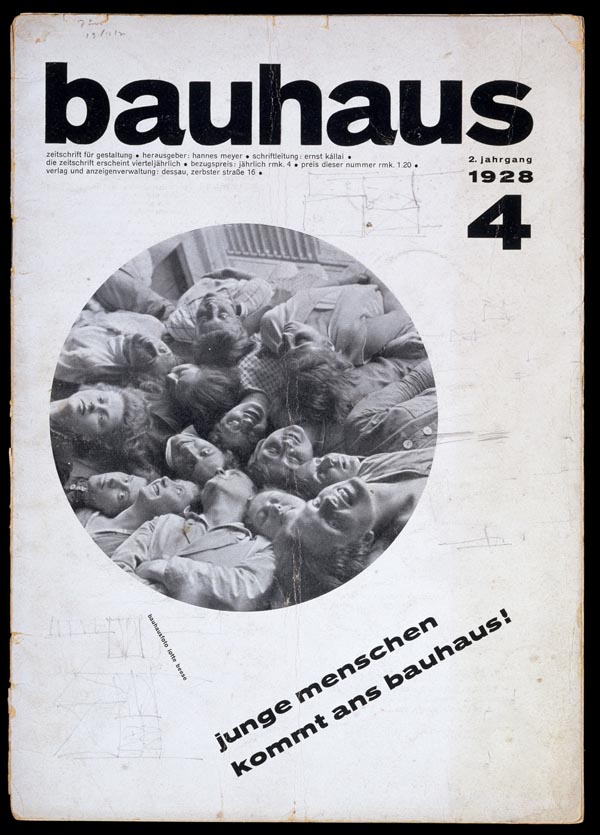 |
| Bauhaus Magazine, vol.2, no.4, 1928. Hannes
Meyer é designado por "Editor". A partir de 1928 Meyer passou a
assumir as funções de «Direktor des Bauhaus». Capa de Joost Schmidt (1893–1948). |
No ano seguinte, Meyer trouxe até à Bauhaus funcionalistas como Hans Wittwer; mais tarde também chamou Ludwig Hilberseimer. Na sua função de director, Meyer rejeitou o individualismo vanguardista que tinha reinado nos anos de Gropius, e impeliu a Escola numa direcção mais pragmática e profissional.
Enfatizou as possibilidades da produção em massa. Esta mudança leva Meyer a desenvolver a Oficina de Tipografia e Publicidade (introduzida por Herbert Bayer em 1927) e colocá-la debaixo da orientação de Joost Schmidt – para produzir Publicidade e rendimentos de vendas.
|
Escola Sindical de Bernau Num concurso proposto pela Associação Sindical Alemã para construção da Escola Estatal para a Federação dos Sindicatos de Bernau, Meyer, o seu sócio Hans Wittwer e o Departamento de Arquitectura da Bauhaus apresentaram o projecto vencedor. Foi concebido um complexo onde as operações de ensino, rotinas diárias e instalações de repouso foram integradas harmoniosamente. Foram construídos 4 blocos residenciais dispostos em “escada”. Os estudantes eram acomodados em quartos duplos, cada conjunto de 5 quartos duplos era tratado como uma unidade, cujos residentes viviam em conjunto durante a estadia de 4 semanas, durante as refeições, jogos e estudos. Havia três grupos de 10 pessoas em cada um dos 3 andares de blocos residenciais. Um corredor de vidro ligava os blocos de alojamentos oferecendo a vista para a paisagem exterior. A decoração do interior da Escola de Bernau foi feita pelas oficinas da Bauhaus. Para além dos blocos residenciais foi construído um 5º bloco destinado ao pessoal, onde os arquitectos fizeram das 3 chaminés do aquecimento a óleo o motivo dominante da entrada do edifício; talvez tenham procurado simbolizar os 3 pilares do Movimento Operário: cooperativa, sindicato e partido. |
Logo que assumiu a direcção, Hannes Meyer fez uma reformulação de todo o curso com base em debates e com a participação de todos — inclusive dos estudantes.
«Queríamos modificar e substituir toda a base pedagógica do Instituto por uma base de Sociologia, Economia e Psicologia». Essa reformulação valorizava a racionalidade, o materialismo e o ensino científico — e embora fossem apoiadas pela maioria, eram posições opostas a alguns dos nomes de maior peso na Bauhaus.
O objetivo da Arquitectura devia de ser o bem-estar das pessoas. A Arquitectura devia harmonizar as necessidades do indivíduo com as da comunidade.
Fizeram parte de seus planos a valorização do trabalho em colectivo, com a especialização de cada um dos membros melhorando sensivelmente o desempenho das equipas.
Outro ponto foi o de a Bauhaus participar em vários concursos públicos e os concorrentes da Escola estarem organizados em grupos onde cada um contava com novatos, alunos mais experientes e professores.
Outra inovação foram realizações de frequentes de palestras e cursos sociológicos e biológicos, com a participaçao de figuras proeminentes, que deram a estas ciências um maior protagonismo na Bauhaus.
Durante a sua direcção, Meyer colocou a Bauhaus numa posição contemporânea: critérios sociais e científicos foram tratados como componentes da mesma importância no processo de elaboração dos projectos.
Meyer respondia à miséria e pobreza em que largas camadas da população viviam, e procurava ao mesmo tempo sistematizar os conhecimentos científicos e sociais disponíveis, integrando-os em todas as oficinas.
As actividades das oficinas deixaram de estar baseadas em cores primárias e formas elementares, para ficarem focadas em questões de utilidade, de preços baixos e do grupo social a quem se dirigia a produção.
Desapareceram as soluções no espírito de um construtivismo estético; os produtos tornaram-se "necessários, correctos e consequentemente o mais neutral ... que é possível conceber".
Meyer conseguiu aumentar de forma espantosa a motivação de trabalho dos estudantes. Atingiram-se notórios sucessos colectivos:
- o apartamento popular,
- o equipamento da Escola Sindical (1928–1930), a Bundesschule des ADGB,
- os apartamentos modelo do Bairro Törten e
- cozinhas protótipo para a Reichsforschungsgesellschaft.
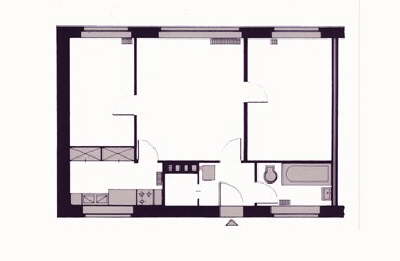 |
| Hannes Meyer: Laubenganghäuser |
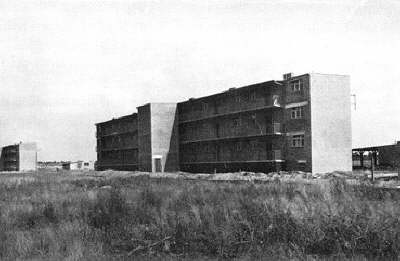 |
| Laubenganghaus, 1930. |
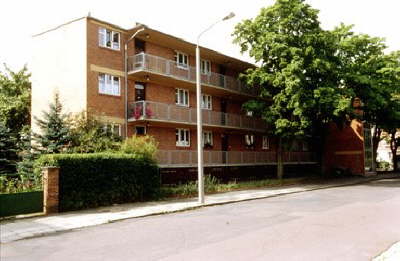 |
| Laubenganghaus na Peterholzstraße, 2000. Foto: Harald Wetzel. |
O ensino de Arquitectura sob a direcção de Hannes Meyer
Meyer fez uma reforma radical em toda a estrutura da escola. A reorganização quase completa da Escola Bauhaus por Hannes Meyer reflectia o desejo do novo director de redirigir as intenções sociais e políticas da Bauhaus.
Deu prioridade aos ideais cooperativos: cooperação, equilíbrio harmonioso do indivíduo e da sociedade.
O recém-criado Curso de Arquitectura foi dividido em duas partes:
- Teoria da Arquitectura, com duração de 4 semestres
- Construção Prática, com duração de 5 semestres.
O curso tinha uma duração total de 9 semestres. A Teoria da Arquitectura tinha como disciplinas: aquecimento, estática, ventilação, design de construção, materiais, cálculos dos raios solares e desenho técnico.
A Construção Prática tinha como actividades:
- o processamento de projectos para edifícios pequenos,
- o trabalho em conjunto em “células cooperativas” para encomendas de grande envergadura (ex: Bairro Törten )
- a tese final e actividades independentes dos estudantes.
Meyer acreditava que a Arquitectura deveria ser exercida não apenas por um profissional isolado, mas por uma equipe criativa de vários especialistas (o especialista em materiais de construção, o mestre condutor de pequenas cidades, o colorista, etc.), que seriam cada um deles um instrumento de cooperação: as células cooperativas.
As teses finais poderiam abordar projectos reais ou fictícios e deveriam conter um conjunto de planos completado por um relatório explicativo. A ambição de Meyer foi de formar uma nova geração de arquitectos que percebesse as necessidades sociais e a responsabilidade social no exercício da Arquitectura...
Urbanizaçao Junkers ( Junkers-Siedlung, 1932 )
Depois de Hannes Meyer ter sido demitido da direcção da Bauhaus, foi o arquitecto Mies van der Rohe que tomou o cargo de director. O Departamento de Arquitectura da Bauhaus construiu um bairro de operários da fábrica Junkers em 1932, cujo projecto foi executado por uma cooperativa de sete pessoas.
A urbanização foi orientada no sentido leste – oeste e a densidade de desenvolvimento e populacional eram baseadas em números das classes trabalhadoras de Dessau.
O centro do bairro residencial para 20000 habitantes era ocupado por espaços para tempos livres e incluia: um campo desportivo com bancada para espectadores, piscinas, café e quadras de ténis. Havia também clubes para atividades comunitárias.
Os habitantes seriam alojados em “comunas”. As refeições deveriam ser centralizadas, por isso as casas só tinham uma kitchnette. Próximos aos apartamentos havia creches e um hospital. As escolas e internatos ficavam numa área própria, em terrenos semelhantes a um parque.
Os ideais de planeamento também foram aplicados ao tráfego, este ficaria longe das áreas para peões, com passagens secundárias e vias de acesso, aliviando as zonas interiores dos grupos de blocos de apartamentos.
Neste projecto as utopias sociais foram transformadas em realidade, tal como o conceito mais radical da Bauhaus se tornou realidade — pela última vez.
1930: depois da bauhaus, moscovo
Seguindo a sua vocação social e política, Hannes Meyer aceitou o cargo de Director da Academia de Arquitectura em Moscovo. Junto com ele vão alguns estudantes e colaboradores da Bauhaus - a «Brigade Meyer».
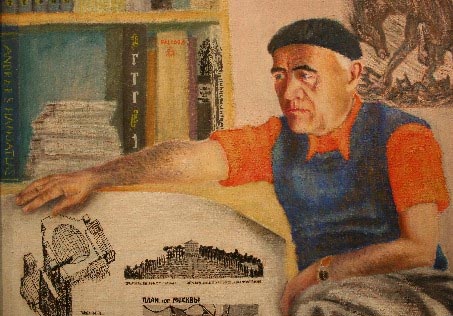
Em 1939, Meyer foi para o Instituto de Urbanismo y Planificación, no México.
Em comissões estatais, e como funcionário do Ministério do Trabalho, trabalhou aí entre 1942 e 1949, realizando — com o tinha feito em Geneva - projectos de urbanismo. No ano de 1949 regressou à Suíça, onde morreu no dia 19 de Julho.
Temas relacionados
«Construir é um processo biológico» - um manifesto de Hannes Meyer, datado de 1928.
Bibliografia
Wer hat Angst vor Hannes Meyer? Ein verfluchter Architekt / von Hermann Funke / Die Zeit. http://www.zeit.de/1967/08/Wer-hat-Angst-vor-Hannes-Mever
Bauhaus-Archiv u.a. (Hrsg.): Hannes Meyer. Architekt Urbanist Lehrer 1889-1954. Berlin 1989
M. Hays: Modernism and the posthumanist subject: the architecture of Hannes Meyer and Ludwig Hilberseimer. Cambridge 1992
M. Kieren: Hannes Meyer - Dokumente zur Frühzeit, Architektur- und Gestaltungsversuche 1919-1927.
U. Poerschke: Funktion als Gestaltungsbegriff. Dissertation BTU Cottbus 2005
C. Schnaidt: Hannes Meyer. Bauten, Projekte und Schriften, Buildings, projects and writings. Teufen 1965
K. Winkler: Der Architekt Hannes Meyer - Anschauungen und Werk. Berlin 1989
H. Prignitz: TGP: ein Grafiker-Kollektiv in Mexiko von 1937–1977. Berlin 1981
H. Prignitz-Poda: Taller de Gráfica Popular – Werkstatt für grafische Volkskunst: Plakate und Flugblätter zu Arbeiterbewegung und Gewerkschaften in Mexiko 1937–1986. Berlin 2002, ISBN 3-935656-10-6
B. Merten: Der spezifische Beitrag Hannes Meyers zum Bauhaus. Magisterarbeit, Rheinische Friedrich-Wilhelms Universität Bonn, 2005,
Hannes Meyer / Vida y Obra. Patricia Barbero Rivadeneyra. México: UNAM, Facultad de Arquitectura, 2004.
.
Meyer scientized the training by introducing additional technical,
natural science and humanities subjects. For the Bauhaus work, he defined a new
social target group: "People's needs, not luxuries". At the Bauhaus, Meyer
taught architecture from 1927-1928, and become director of the Bauhaus from
1928-1930 and head of the Architecture Department. From 1930 to 1936, Meyer was
an urban planner and lecturer in the Soviet Union. From 1938 to 1949 he was a
lecturer, city planner and architect in Mexico.
Meyer was born in Basel,
Switzerland, in 1889, into a family of architects. He trained as a mason, and
practiced as an architect in Switzerland, Belgium, and Germany, briefly serving
as a department head at the Krupp Works in Essen. In Zurich he co-founded the
architectural magazine 'ABC Beiträge zum Bauen' (Contributions on
Building) in 1923. Meyer's design philosophy was based on examining daily
routine of people who live in the houses, creating the functional diagram. This
functional diagram and the economic programme become the determining principles
of his future building projects. In 1926 Meyer established a firm with Hans
Wittwer and produced his two most famous projects, for the Basel Petersschule
(1926) and for the Geneva League of Nations Building (1926/1927). Both projects
are strict, inventive, and rely on the new possibilities of structural steel,
but neither was built.
In April 1927, Walter Gropius appointed Meyer head of
the Bauhaus, Dessau architecture department. Meyer brought his radical
functionalist viewpoint that architecture was an organizational task with no
relationship to aesthetics, that buildings should be low cost and designed to
fulfill social needs.
After he became Bauhaus director in February 1928, he tightened the program around architecture and industrial design, forcing the resignations of Herbert Bayer, Marcel Breuer, and other figures. In an increasingly dangerous Weimar political atmosphere, Meyer's own outspoken communism and the growth of the Communist student organization in the Bauhaus became a threat to the existence of the school. Eventually, Dessau's municipal government, afraid of losing votes, fired him with a monetary settlement, on August 1, 1930. From Russia to Mexico Meyer responded to his dismissal from Bauhaus by taking seven students and a secretary to Moscow, forming a group they called the "Left Column". This was a parallel effort to Ernst May's "May brigade". Both groups worked on architectural and urban planning projects guided by socialist-utopian ideals.
The Soviet Union dismissed all such foreigners in 1936. Meyer returned to Geneva for three years, then emigrated to Mexico City to work for the Mexican government as the director of the Instituto del Urbanismo y Planification from 1942 through 1949. In Mexico City he also served as the director of Estampa Mexicana, the publishing house of the Taller de Gráfica Popular (the Popular Graphic Arts Workshop). In 1942 he was with his friend the Italian photographer Tina Modotti the night she died under mysterious circumstances. Meyer returned to Switzerland in 1949, and died in 1954.
Viele seiner Bauprojekte sind charakterisiert durch die
Genossenschaftsbewegung. Eines der bedeutendsten Projekte war der
Völkerbundpalast in Genf.

 Topo
página
Topo
páginaQuer usar este texto em qualquer trabalho jornalístico, universitário ou científico? Escreva um email a Paulo Heitlinger.
